

Working professionals waste an average of 60–70% of certification course time relearning skills they already know. Efficient certifications for working professionals require three distinct steps:
1/ assess existing knowledge
2/ identify specific gaps
3/ choose platforms that provide personalised learning roadmaps instead of cookie-cutter syllabi
The result: certifications in weeks instead of months, costing ₹500–2,000 instead of ₹30,000–1,50,000.
Most professional often have skills and experience, but without certificates to prove it, they remain invisible to recruiters. Meanwhile, traditional certification programs demand months of time and thousands of rupees to certify skills they already possess.
The question isn’t whether certifications and credentials matter – we know they do. Research shows that 91% of hiring managers consider certifications a crucial factor in hiring decisions. The real question is: how do you get the right certifications without wasting time and money on content you already know?
The Evidence on Certification Value
Picture this. You already know your job – and just need to learn some new update tools or skills. You’ve been doing it for 3-5 years. Your managers know your capabilities. Your colleagues trust your work. But recruiters? They look past you because your resume lacks a formal credentials.
So you make a decision: ‘I’ll get certified.’ You find a well-known platform. It promises 40 hours of learning. It costs ₹40,000. You click enroll. Within the first week, you realize something infuriating: you’re spending hours relearning basics you’ve known for years.
By hour 25, you’ve wasted ₹12,500 of your investment. By hour 40, you’ve wasted nearly ₹20,000 in direct costs alone. You’re paying ₹1,600+ per useful hour.
Most platforms assume learners start from zero. They design every course as a complete journey from beginner to competent. This works for career changers. For experienced professionals, it’s catastrophically wasteful.
Efficient certifications for working professionals are the key to upskilling in 2026
Research shows that certified engineering graduates in India are about twice as likely to secure employment after receiving an online-skills certificate.
The Indian professional certification market is projected to grow rapidly, reaching over $5.16 billion by 2029, driven by strong demand for upskilling and verified credentials.
Efficient certifications for working professionals should deliver measurable returns:
- SHRM certifications can lead to up to 35% higher pay and improved access to senior HR roles.
- PMP-certified professionals in India earn an average of ₹12.5 lakhs per year, with top salaries reaching ₹28 lakhs.
- Certified DevOps Engineers in India command salaries ranging from ₹8 lakhs to ₹40 lakhs per annum, depending on experience.
- Solutions Architects holding cloud or architecture certifications earn an annual average of ₹30.4 lakhs.
The pattern is clear: certifications open doors and increase earning potential. But there’s a critical problem with how most people obtain them.
The Real Problem: Not Quantity, But Certification Efficiency
We’re witnessing a fundamental recalibration in how the job market values credentials. Today’s job market values ability to learn and apply new skills fast. This represents a maturation of the industry’s relationship with learning—a move away from naive credential-counting toward more sophisticated assessments of capability.
Most courses though are modelled on traditional educational systems. They have a set syllabus. And they are designed for beginners to advanced folks. So they are expensive, and waste time.
What working professionals actually need is this:
- A way to know which skills of theirs are relevant in the current job market, and what they need to learn
- A way to learn while they are on the job – micro lessons that allow them to build learning habits
- Accessible educational assessments that allow them to demonstrate their skills
- Learning roadmaps which are personalised to their position
- A way to do this credibly
Measurable skill outcomes refers to whether the certification process actually tests your ability to perform specific, job-relevant tasks. Application is perhaps most critical—can you actually use what you’ve learned? A certificate becomes valuable when it reflects skills you can immediately deploy in a professional context. If you can’t apply the learning in real scenarios, the certificate is just decorative.
Platforms like Coursera, Udemy, and edX have made learning accessible, but they operate on a fundamental assumption: every learner starts from zero. For those who learn from YouTube and other free online sources, the question remains: How do you validate what you’ve learnt?
Coursera offers high-quality university-partnered courses, but they’re structured as complete programs. A data science specialization might include 6-8 courses covering everything from basic statistics to advanced machine learning. Which means a lot of time is wasted on basic things when a person already knows most of it and is trying to learn something he immediately wants answers to. And you still pay for the entire specialization—often ₹30,000-80,000—and spend months working through content you don’t need. Their certificates are recognized, but the path to get them is inefficient for experienced professionals.
Udemy provides affordable individual courses (₹500-3,000), but quality varies dramatically and there’s no assessment of existing knowledge. You purchase a 40-hour course hoping it covers what you need, only to discover hours 1-25 review basics you already know, and the advanced content you needed occupies just the final 3 hours. There’s no way to test out of content or get a personalized path.
edX offers university-level courses and professional certificates, with better quality control than Udemy but similar structural problems as Coursera. Their MicroMasters and Professional Certificate programs cost ₹20,000-₹1,50,000 and assume you need comprehensive coverage. If you’re an experienced professional who needs targeted upskilling, you’re paying for breadth you don’t need.
All three platforms share the same limitations:
- No mechanism to certify existing skills without taking full courses
- No personalized learning paths that skip content you already know
- No adaptive assessments that identify specific knowledge gaps
- Limited focus on quick job placement after certification
- Pricing models based on comprehensive courses, not targeted learning
How Many Certifications Do You Actually Need?
The answer depends on your career stage and goals:
Entry-Level Professionals (0-3 Years): 2-3 targeted certifications that demonstrate core competencies. Focus on foundational skills plus one specialization aligned with your target role. At this stage, certifications compensate for limited work experience and signal your commitment to the field.
Mid-Career Advancement (5-8 Years): 3-4 certifications, including at least one premium credential. Balance breadth (showing you understand the ecosystem) with depth (proving specialization). These certifications should support promotion to senior or lead positions.
Career Switchers: 4-5 certifications that create a logical bridge from current expertise to target role.
Senior Professionals (15+ Years): 1-2 strategic certifications every 2-3 years to maintain currency. Right now, an efficient certification for a person. Focus on advanced credentials that build on existing expertise rather than foundational courses. These certifications signal you’re keeping pace with industry evolution.
The key insight: you need multiple certifications throughout your career. What matters is getting them efficiently—proving existing skills quickly and learning new skills without redundancy.
The Three Critical Gaps in Current Certification Approaches
Current certification pathways fail to address three specific needs of Indian professionals:
Gap 1: No fast-track for experienced professionals. If you’ve been using AWS for three years in production environments, you understand concepts that beginners need months to learn.
But traditional certification paths require everyone to complete the same content sequence. There’s no “test out” option, no way to prove existing knowledge and jump to certification.
Gap 2: No granular, topic-specific learning. Career advancement often requires mastering one specific advanced topic, not learning an entire domain from scratch.
If you need to understand Kubernetes security specifically, or React Hooks in depth, or advanced SQL optimization, you shouldn’t have to purchase and complete comprehensive courses covering the entire technology stack.
Gap 3: No direct connection to employment outcomes. Most platforms provide certificates but offer minimal job placement support. They might have a job board or career resources, but there’s no structured pathway from certification to interview to employment.
For professionals in tier-2 and tier-3 cities who lack extensive professional networks, this gap can mean certifications that don’t translate to career advancement.
The Strategic Framework: Quality Signals That Get You Hired
Beyond just accumulating certificates, focus on these quality indicators:
Verifiable assessments: Certifications that test your ability to apply knowledge in real-world contexts matter more than completion badges. Employers want proof you can use skills, not just recognize concepts in multiple-choice questions.
Relevant credentials: Every certification should directly support your career goals. If you’re targeting data engineering roles, certifications in graphic design or content marketing don’t help—they confuse your professional narrative.
Industry recognition: Focus on credentials that hiring managers immediately understand and value. AWS, Google, Microsoft, PMI, SHRM, CISSP represent meaningful certifications with established market value. Adding a soft skill certification – like leadership skills or negotiation- will help you stand out.
Practical demonstration: Combine certifications with portfolio projects. Certificates prove you learned something; projects prove you can apply it. The combination is powerful.
Recent and current: Certifications older than 3 years in fast-moving fields like technology lose credibility. Either renew them or remove them from your resume.
Strategic timing: Get certifications when they unlock specific opportunities—a promotion, a career switch, or entry into a new field. Don’t accumulate them hoping opportunities will eventually appear.
What is the Solution? Efficient, Personalized Certification Pathways
What professionals need is fundamentally different from what traditional platforms offer. The ideal approach would:
- Allow experienced professionals to certify existing skills without relearning basics
- Assess current knowledge before creating learning paths
- Generate personalized courses focused only on knowledge gaps
- Connect certifications directly to employment opportunities
- Cost significantly less than comprehensive programs
- Deliver results in weeks, not months
This is exactly what LearnTube provides through three distinct solutions designed for different professional needs:
For experienced professionals who already have skills but lack proof of skill
LearnTube’scertified platform (certified.learntube.ai) allows you to prove your existing competency and assess gaps through gamified adaptive assessments. Take a 10-question assessment that adjusts difficulty based on your performance, earn badges demonstrating your knowledge level, and receive certification.
The assessment is free; certificates cost ₹219-₹999. Compare this to Coursera’s ₹30,000-80,000 specializations or edX’s ₹20,000-₹1,50,000 professional certificates that require completing entire programs regardless of existing knowledge.
For professionals learning new specific skills
LearnTube’s personalise platform (personalise.learntube.ai) generates custom courses focused entirely on your knowledge gaps.
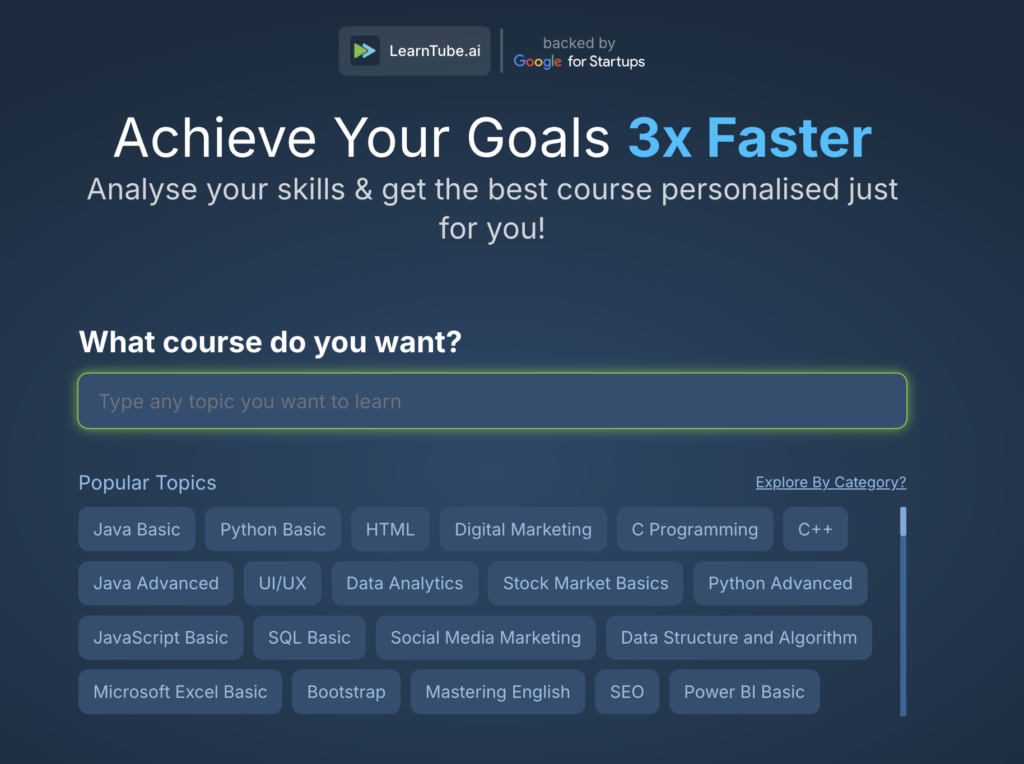
Enter the specific topic you need (like “Python Internals” or “Kubernetes Security”), take a brief assessment identifying what you already know, and receive a personalized course covering only what you’re missing. The assessment is free; personalized courses start at ₹399.
This contrasts with Udemy’s one-size-fits-all courses (₹500-3,000) where you can’t skip content you already know, or Coursera’s comprehensive programs that assume you start from zero.
For employment readiness
LearnTube’s Placement Bootcamp (available as an add-on to Personalise courses) provides LinkedIn profile optimization (activated immediately after you make the first purchase), CV writing, mock interviews, communication skills, and strategic leadership training.
Combined with LearnTube’s network of 1100+ hiring partners, this creates a direct pathway from certification to employment- something that Coursera’s job boards, Udemy’s career resources, and edX’s alumni networks don’t match in terms of structured support and direct employer connections.
For professionals who already have the skills but lack formal validation, LearnTube.ai Certified bridges the credibility gap without wasting time or money.
Instead of sitting through long, repetitive courses, learners take a 10-question adaptive assessment that dynamically adjusts difficulty based on their performance. Each response unlocks badges that reflect real ability and growth potential, making the process both engaging and insightful.
It’s a gamified, efficient, and credible way to prove what you already know intantly.
The assessment is completely free, and learners can download their verified certificate for just ₹219–₹999, a fraction of what other platforms charge for similar recognition.
For experienced professionals, Certified transforms skill validation from a drawn-out formality into a fast, rewarding experience that employers respect.
The fundamental difference: traditional platforms sell courses; LearnTube provides certification pathways.
If you already know Python but need a certificate, you don’t pay for and sit through a 40-hour Python course – you prove what you know and get certified immediately. If you need to learn one specific advanced topic, you don’t purchase comprehensive programs – you get precisely the content that fills your gaps.
For professionals who need efficient, affordable pathways to certification and employment, this difference is transformative.
The choice isn’t just about price (though ₹399-999 versus ₹30,000-80,000 matters significantly). It’s about respecting your time, recognizing your existing knowledge, and connecting your certifications directly to career advancement.
Other Platforms That Offer Certificates
Coursera:
Coursera partners with top universities and global companies to offer structured professional certificates and degree programs.
While these credentials carry strong academic credibility, they typically require learners to complete entire multi-module courses lasting 3–6 months. Even experienced professionals must go through foundational content they may already know, with costs ranging from ₹30,000 to ₹80,000 per specialization.
Udemy:
Udemy offers a vast library of affordable courses where learners receive a certificate of completion after finishing a video-based program. However, the platform follows a one-size-fits-all model—you can’t skip lessons or test out of topics you already understand.
Certificates hold value as proof of participation but are not benchmarked to hiring standards, and most courses cost ₹500–₹3,000 without any adaptive learning.
edX:
edX provides university-backed professional certificates, micro-degrees, and executive programs from leading institutions worldwide.
The certificates are academically rigorous and globally recognized but come with a significant investment—₹20,000 to ₹1,50,000—and long completion timelines. Learners must finish entire course sequences, making it less practical for working professionals seeking fast validation of existing expertise.
How does a an efficient professional certification impact your career?
Saikrishna P. M., 27, from Kochi, worked as a QA Engineer at CathX Ocean, testing camera systems for AUVs. Despite completing multiple courses, none gave him credible validation of his applied skills.
When he took LearnTube’s QA Automation Certification, the questions mirrored real subsea engineering scenarios he dealt with daily. It wasn’t theory — it was reflection. The certification helped him prove expertise in critical environments where precision matters most, leading to faster, more stable testing processes at work.
The micro-certification case:
Kanthraj H., 45, from Bengaluru, had years of experience but never saw certifications as engaging—until he found LearnTube.
Exploring its micro-certification model, he earned 197 verified certificates across skills as diverse as corporate communication, photography, and horticulture within 20 hours. Each certification tested practical understanding rather than memorization.
What began as curiosity turned into a record-setting learning marathon and a lifelong belief: certification should be both credible and fun.
The experience validation case:
Tituranjan Swain, 52, from Bhubaneswar, spent two decades managing operations and logistics but lacked formal proof of his expertise. Recruiters wanted credentials, not stories.
Through LearnTube’s Six Sigma Certification, he demonstrated mastery in process optimization and quality improvement — skills he had practiced for years. The certification gave him not just credibility but renewed professional confidence to showcase experience in a language recruiters recognize.
The transformation case:
Shivam Mukati, 25, from Indore, discovered cybersecurity through LearnTube certifications that clarified core concepts and built a foundation for advanced credentials like CompTIA CySA+ and CISM. The certification journey transformed him from learner to leader — he went on to create his own cybersecurity community and eventually collaborated with LearnTube as an industry partner. Certification became the bridge between learning and leadership.
Conclusion: Get More Certifications, But Get Them Strategically
The evidence supports obtaining multiple certifications throughout your career. They matter to hiring managers, they increase salaries, and they open opportunities.
The question isn’t whether to get certified—it’s how to get certified efficiently without wasting time relearning skills you already have or paying for comprehensive programs when you need targeted knowledge.
For Indian professionals navigating competitive job markets with limited time and financial resources, strategic efficiency isn’t just convenient—it’s essential.
Every week spent on redundant learning is a week not earning. Every rupee spent on unnecessary content is a rupee that could support your family or invest in your future.
Next Steps: Assessment Before Investment
Before investing in another traditional certification program, start with assessment:
If you already have skills but lack certificates: Test whether you can certify your existing competency immediately rather than spending months relearning what you already know.
If you need to learn new skills: Identify exactly what you’re missing before purchasing comprehensive courses that cover topics you don’t need.
If you want certifications to lead to employment: Consider structured placement support rather than hoping your certificates will eventually attract recruiter attention.
The choice between traditional platforms and newer, more efficient approaches comes down to this: do you want to buy courses, or do you want to advance your career? Sometimes those are the same thing. Often, they’re not.
In 2026, the professionals who advance fastest aren’t those who accumulate the most certificates. They’re those who get the right certificates efficiently—proving what they know quickly, learning what they need affordably, and connecting their credentials directly to career opportunities.