


If you’re a fresher trying to land your first tech job in 2026, learning SQL is a good place to start. Jobs that use SQL include data analyst, MIS, database and ETL trainee roles, and many are open to freshers. But is it enough to get hired?
SQL helps you retrieve, filter, combine and analyse data stored in databases. It is used in data analytics, business intelligence, software development and database-related work. However, knowing how to write a basic query and being able to solve a problem using data are two different things.
For example, you might know how to retrieve a company’s sales records using SQL. But can you identify which products are underperforming, compare sales across regions and explain what the business should investigate next?
That is the difference between knowing SQL and demonstrating that you can use it at work.
AI has also changed how people work with SQL. Tools can help generate queries, explain errors and speed up repetitive tasks. You still need to understand the data, verify the results and explain what they mean.
Is SQL Enough to Get a Job as a Fresher in 2026?
Yes, SQL can help you qualify for certain entry-level roles, but knowing only basic SQL may not be enough to compete for many data analyst positions. Many data analyst roles also ask for Excel, a visualisation tool such as Power BI or Tableau, and the ability to interpret data.
Some roles focus heavily on querying databases, preparing reports or supporting database operations. Python may be useful or required, depending on the employer. In AccioJob’s analysis of 328 data analytics job descriptions (July 2026), Excel appeared in 81%, SQL in 60%, Power BI in 43% and Python in 41%.
The skills you need depend on the job you’re targeting. For example, a reporting role may require SQL and Excel to retrieve, organise and summarise data. A data analyst role may also involve building dashboards and explaining trends. A database-focused role may require knowledge of database design, performance and maintenance.
What SQL skills should a fresher know?
Start with the fundamentals, then progress to more complex queries.
- Basic SQL: Learn how to retrieve specific columns, filter records, sort results and group data. Practise using SELECT, FROM, WHERE, ORDER BY, GROUP BY and aggregate functions such as COUNT() and SUM().
- Intermediate SQL: Practise joins, subqueries, Common Table Expressions (CTEs), CASE statements and window functions such as ROW_NUMBER() and RANK().
- Database fundamentals: Understand tables, data types, primary keys, foreign keys and how tables relate to one another.
These topics are relevant for aspiring data analysts, although the depth required varies by role. See how SQL joins work and SQL subqueries explained for a closer look.
Which SQL course should a fresher start with?
If you’re starting from scratch, an LearnTube’s SQL Basic Course is a place to begin. You can start by understanding what SQL does, how databases work and how to install a database engine. From there, practise SQL syntax, data types, operators and expressions so you can write queries and work with database records.
Once you’re comfortable with the basics, move on to the SQL Advanced Course. This helps you progress towards more complex queries, subqueries, joins, indexes and other database concepts.
You can also learn through the SQL Tamil Course or the SQL Hindi Course, depending on which language helps you learn more comfortably.
What Are the Jobs That Use SQL for Freshers?
Jobs that use SQL include data analyst, MIS or reporting executive, business analyst, junior database administrator, junior database developer, junior data engineer or ETL trainee, and software developer trainee roles. Freshers can apply for all of them, but each needs additional skills, so check the job description before applying.
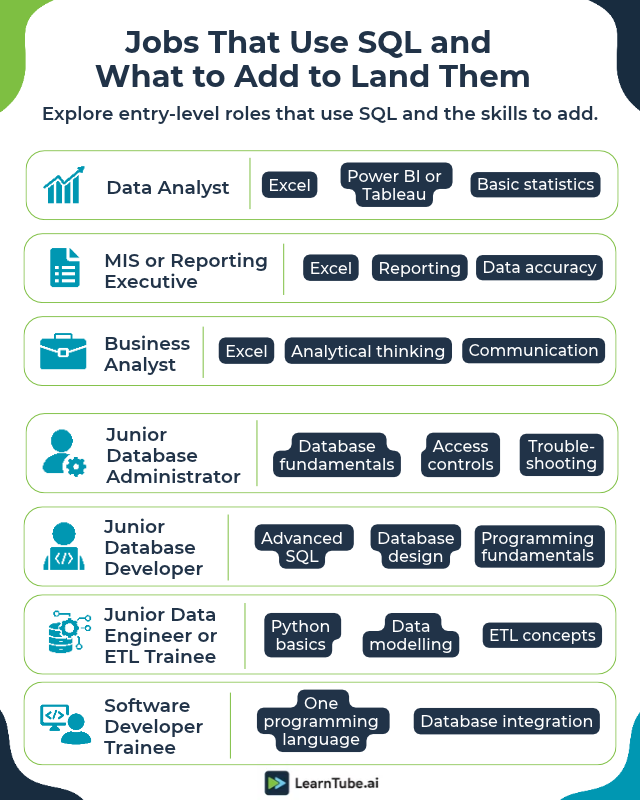
SQL is used across several job roles, but the responsibilities and additional skills differ from one position to another. Jobs that use SQL range from reporting to database engineering.
1. Data Analyst
Data analysts use data to answer questions, identify patterns and help businesses make decisions. SQL helps them retrieve and combine data from databases before analysing it.
Many entry-level data analyst roles also ask for Excel, a visualisation tool such as Power BI or Tableau, and basic statistical knowledge. Python can be useful for automation and more extensive analysis, but requirements vary by employer.
Skills to build: SQL, Excel, Power BI or Tableau, and basic statistics.
2. MIS or Reporting Executive
MIS and reporting roles often involve collecting data, maintaining spreadsheets, preparing recurring reports and tracking business performance.
SQL can help you extract data from databases, while Excel can help you organise and summarise it. Depending on the employer, you may also need to work with dashboards or reporting systems.
Skills to build: SQL, Excel, reporting and data accuracy.
3. Business Analyst
Business analysts study business processes, requirements and performance to identify problems and recommend improvements. In analytics-focused roles, SQL can help them investigate data and check whether a business problem is reflected in the numbers.
The role may also require communication, documentation and an understanding of business processes. Not every business analyst position requires SQL, so check the job description before applying.
Skills to build: SQL, Excel, analytical thinking and communication.
4. Junior Database Administrator
Database administrators help maintain databases, manage access, monitor performance and support data security and availability.
SQL is useful for interacting with databases, but database administration involves more than writing queries. You may also need to understand backups, permissions, troubleshooting and database maintenance. Some employers expect relevant technical qualifications or experience.
Skills to build: SQL, database fundamentals, access controls and troubleshooting.
5. Junior Database Developer
Database developers work on database structures, queries and database-related functionality used by applications. Their work may include writing complex queries, creating database objects and improving query performance.
For this path, you’ll need a deeper understanding of SQL and relational databases. Knowledge of programming and application development may also be useful, depending on the role.
Skills to build: Advanced SQL, database design and relevant programming fundamentals.
6. Junior Data Engineer or ETL Trainee
Data engineers build and maintain systems that move, transform and prepare data for analysis. SQL is useful for querying and transforming data, but the role may also require Python, data pipelines, cloud platforms and ETL tools.
These positions can be more technically demanding than entry-level reporting roles. Look for trainee or junior openings whose requirements match your current skills.
Skills to build: SQL, Python basics, data modelling and ETL concepts.
7. Software Developer Trainee
Software developers may use SQL to store, retrieve and update information used by an application. For example, an application might use a database to manage customer accounts, product information or orders.
However, SQL is only one part of software development. You’ll usually need a programming language, an understanding of application logic and other skills relevant to the position.
Skills to build: SQL, one programming language and database integration.
Are SQL Jobs in Demand? SQL Career Path and Scope
SQL jobs are in demand in data and analytics hiring. In AccioJob’s analysis of 328 data analytics job descriptions (July 2026), SQL appeared in 60% of them, behind only Excel at 81%. Demand varies by city, employer and role, so check current listings for the role you want.
A typical SQL career path starts with a reporting or analyst trainee role and can lead to senior analyst, database developer or data engineering roles as you add skills.
How Has AI Changed SQL Jobs in 2026?
AI tools can help people generate SQL queries from written instructions, explain unfamiliar code, suggest fixes for errors and draft data summaries. This can speed up parts of an analyst’s workflow, but the output still needs to be checked.
For example, if you need to check, “Which products generated the most revenue last month?”
An AI assistant may help draft a query that groups sales by product and calculates revenue. But you still need to check whether the query uses the correct date range, joins the right tables, handles refunds appropriately and calculates revenue as your company defines it.
A query can run without errors and still return the wrong answer.
What changes when AI can write SQL?
| Working with SQL without AI assistance | Working with SQL alongside AI |
| Writing queries manually from the beginning | Using AI to draft queries and then reviewing them |
| Looking up syntax and troubleshooting errors yourself | Asking AI to explain errors and suggest fixes |
| Building reports through manual steps | Using AI to speed up parts of reporting and data preparation |
| Checking results using your own knowledge | Validating AI-generated results against the data and business rules |
This is a comparison of possible workflows, not a claim that every organisation has adopted these changes. The extent of AI use varies by team, tool and role.
Will AI replace people who know SQL?
It’s too early to say that AI will eliminate SQL-related jobs. AI can assist with some tasks that previously required more manual work, while database design, data quality, security and business-specific decisions still require careful human oversight.
For freshers, this means learning SQL alongside AI tools can be useful. Relying on AI to write every query without understanding it, however, makes it harder to spot mistakes or explain your results.
Practise writing queries yourself first. Then use AI to explore alternative approaches, understand errors or improve your solution. Finally, run the query, inspect the results and explain why the output answers the original question.
Microsoft’s 2026 Work Trend Index found that 63% of Indian AI users ranked quality control of AI output as the most important skill in an AI-powered world, against 50% globally, and 59% ranked critical thinking, against 46% globally (survey of 20,000 AI users across 10 markets).
What Should You Learn After SQL to Get Hired?
After SQL, learn Excel, one visualisation tool (Power BI or Tableau), basic statistics and business communication, and Python if you are targeting analytics or data engineering roles. Also practise checking AI-generated output. Prioritise whichever skills appear in job descriptions for your target role.
You don’t need to learn every programming language or database platform before applying for your first job. Start with the skills that appear in job descriptions for your target role.
1. Excel
Excel helps you clean, organise, analyse and summarise data. Learn formulas, lookups, PivotTables and basic charts so you can work with spreadsheets as well as databases.
2. Power BI or Tableau
These tools help you turn data into dashboards and visual reports. If you’re targeting data analyst or reporting roles, learn one tool well enough to build a dashboard and explain the insights it presents. You don’t need to master both at the beginning.
3. Python
Python is useful for automating repetitive tasks and working with data through libraries such as pandas. It can broaden your options for analytics and data engineering roles, although it isn’t a mandatory requirement for every entry-level data analyst job.
4. Basic statistics and business communication
Learn how to interpret averages, percentages, distributions and trends. Practise explaining what your findings mean to someone who doesn’t work with data. An accurate number is useful only when people understand what it tells them and what it doesn’t.
5. AI-assisted analysis
Use AI to help draft queries, explain code and explore different solutions. Build the habit of checking table relationships, filters, calculations and output before trusting the result. AI should support your analysis, not replace your understanding of it.
How Can a Fresher Prove Their SQL Skills Without Work Experience?
If you haven’t worked with company data yet, personal projects can help demonstrate what you know. A useful project starts with a question, uses data to investigate it and explains the result. This section covers three projects: a sales analysis, a customer purchase analysis and a SQL and Power BI dashboard.
Project 1: Sales analysis using SQL
Use a sample sales dataset to identify top-selling products, calculate monthly revenue and compare performance across regions. Practise filtering, grouping and joining tables.
Project 2: Customer purchase analysis
Use customer and order tables to identify repeat purchases, compare average order values and explore which customer groups contribute the most revenue. This is a good opportunity to practise joins, subqueries and window functions.
Project 3: SQL and Power BI dashboard
Use SQL to prepare a dataset, then build a dashboard in Power BI or Tableau. Include a few useful metrics and explain what the results suggest about the business.
These are suggested portfolio projects, not guarantees of employment. To make them useful, document your questions, queries, findings and limitations. If you publish your work, include a link to your code or dashboard in your resume.
As you build these projects, start with the basics: retrieve data, filter records and understand how database tables are structured. Then practise changing records and working with more complex queries as your confidence grows.
The SQL Basic Course and SQL Advanced Course can help you work through these concepts in stages.
Conclusion
SQL is a valuable starting point if you’re a fresher exploring data and technology careers. Jobs that use SQL are open to freshers who can show projects, not only a certificate. It can help you qualify for roles involving querying, reporting, analysis and database work, but the skills required depend on the position.
AI has made it easier to generate queries and get help with technical problems. That makes it important to understand the queries you use, verify their results and connect your findings to real business questions.
If you’re starting today, focus on three things:
- Build a strong foundation in SQL.
- Add complementary skills based on the jobs you want.
- Complete practical projects that demonstrate how you solve problems with data.
You don’t have to know everything before you apply. Start building your skills, practise on datasets and look for entry-level roles that match what you can demonstrate.
You can begin with LearnTube’s SQL Basic Course and move on to the SQL Advanced Course once you are comfortable with joins and subqueries.